Life in Objects: On Friendship and Time

Life in Objects: Friendship and Time
I often think of my life through objects that lie across my room, pasted on to my walls, resting in my drawers. Cards, presents, pictures, candles, journals. I keep them shelved safely, looking at them periodically without much thought, but never putting them too far out of reach lest I lose them.
Last winter, I met my friend, A, in Chicago. He had just come into town after being overseas. It was a strange time. The pandemic still raged on, and without the comfort of vaccines, we were told to keep to ourselves.
It was very cold. The sun would not come out for days, and I would wake up everyday and push aside the blinds by my bedside window just to see ever rising hills of white. The blinds would hang peacefully all night, only convulsing occasionally to express their displeasure at the howling winds outside.
On some mornings, I would see David from pest control lean his ladder across my window as he went up the roof. With the onset of winter, the squirrels that had been foraging for food out in the yard all fall were now to make home in our walls. The landlord had called David in to do something about them as they kept scratching away at our walls all day long. I did not mind them much. They were just keeping warm like us. But I did worry about David as his head would often hover near the sharp downwards pointing icicles that had latched themselves tightly on to the edge of the roof.
Sometimes the sun felt gracious enough to cast down specks of warmth. I would hasten to stand outside in our yard to catch any and all of the gentle hugs it sent down, any and all of the crisp yet soft rays that it emanated. I loved the fleeting feeling of it gently baking the sides of my cheeks, cherishing the sunburn as it made my skin feel like it were back home. As a child, I would try to find Saturn’s rings in the sky, not knowing how space worked; now I was content with just a fleeting glimpse of our shared star.
Snow had lined our alleys like trees, imitating tall hedges, often trying to reach up my shoulder, trying to dominate me. Many of the people I would spend time with had left town for one reason or another. Isolation weighed heavily on all those who remained.
My neighbour J’s car would often need to be excavated from the snow that had turned into hardened ice but trying to jettison it from its prison without strategy was worse than a hamster on a wheel; the tires would lose all traction, roll over themselves, and screech like a bat.
J would sometimes send me an apologetic text at night asking for my help. Hold on, coming, I would reply. J, could we not have done this just a teeny bit earlier in the day, I would think to myself as I rolled out of whichever blanket I was hibernating under. I would don on my hefty flannel overshirt, grab a shovel from storage, and head out, strangely filled with purpose.
I would hammer the shovel into the ice, sometimes not knowing what I was doing, while J would try to accelerate out at the right moment. In ordinary times, I might have been less thrilled to partake in this fitness challenge, but I did not mind this strange mixture of sweating and freezing now. To stay sane required an intense appreciation for the mundane, to reduce one’s vision from days or months to minutes.
I had always been protective of my solitude but there was something cruel about it being involuntary. I started going out on long walks despite the frigid weather. The monotony of walking the same paths made me feel stuck oscillating in an endless loop. Still, I liked having my face aggressively caressed by arctic winds better than entertaining the eery quietness that would visit my room without invitation.
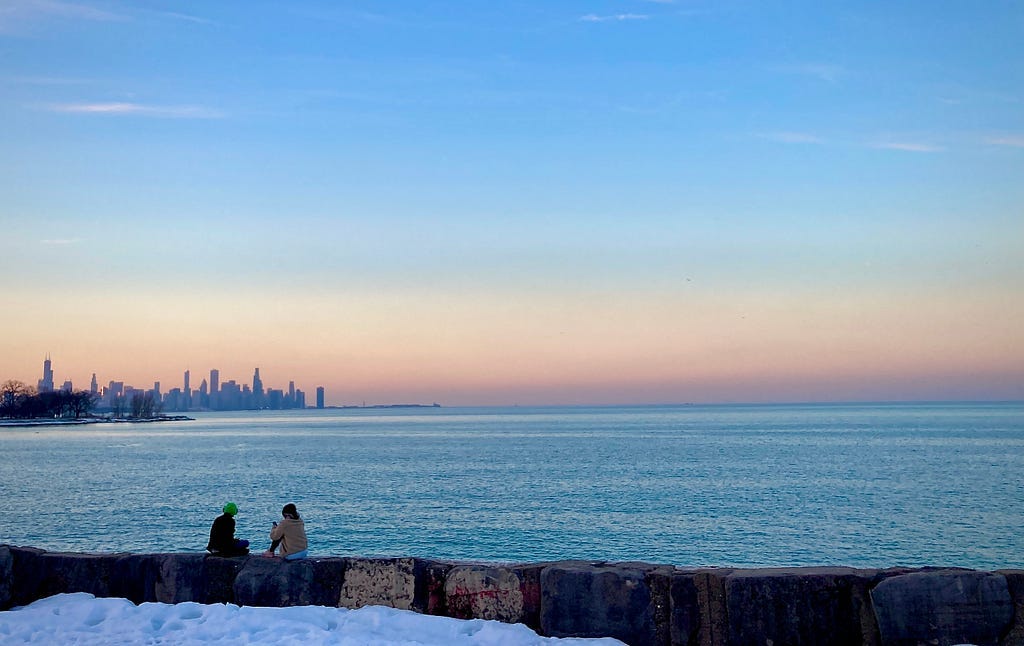
It was important to find life where one could; the leafless trees and the frozen lake would have to do, I thought. The lake would become covered with menacing looking shards of ice but I did not think them to be brutal. They would bobble and brush against the stoned waterfront. They were lovely but in the way sad things are lovely. I could hear the water move. It was comforting. I would stand by the edge, my hands numb in my jacket pocket, gazing at the lake that pretended to be an ocean. The wind would bounce off the water as it leaped ashore to embrace me, snapping me out of this or that reverie, nuzzling my cheeks, brushing my hair aside into tousled waves, making me feel like a little child.
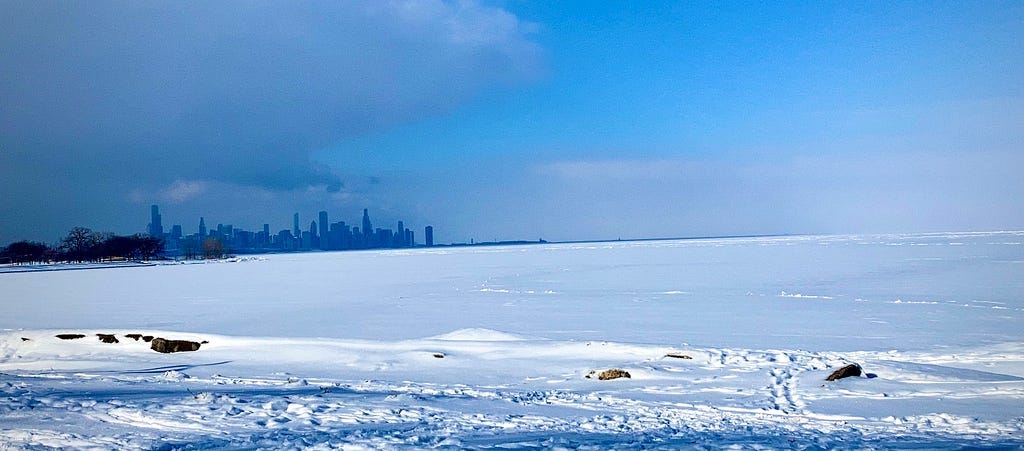
With time, the shards would transmute into a delicate plain of white. As soon as I would put on my shoes to get some air, my feet would, without much volition, take me towards these sheets of cotton gently resting atop the great lake, like imbricated loved ones reunited after a long separation. I wondered if it were a stupid idea to try to walk across it, to run towards the looming skyline. The thought filled me with an unfamiliar exhilaration. My irises would pull at my pupils, nudging them to expand more, to make it all seem more real. It felt like I could not see enough, and at this I felt a strange yet tender sadness.
I would walk past the cafes where we had used to laugh, read, and eat; now they stood darkened against the horizon: empty, forlorn, desperate for company. I missed one of my friends and his coffee snobbery; like the purist he was, he would roll his eyes if I ever made myself instant coffee.
I would often order take-away lattes from one of these cafes that we had frequented, one ostensibly inspired by the French coffee scene, and as I would, I would also hear his voice ring in my head: It’s probably too cold, or too frothy, or too milky. I don’t even know why we come here, I could probably make a better one at home!
Well, you aren’t here, I would think.
Catching a glimpse of someone walking their dog was the grandest possible outcome of any given walk, yet even they seemed more sombre than usual. My feet could feel the ice despite my thick woolen socks. My boots had been giving way for some time now but the idea of going shopping seemed too much.
I would recognize little oddities around Hyde Park that I had put to memory. I had started giving distinct looking houses rather unimaginative names: the red house, the weird house, the big house.
As winter ravaged on, I hoped dearly for spring to come. I could not find solace in the words of many a great writers who had sung praises of winter. It was still beautiful but in the way sad things are beautiful. I missed home; I missed the thought of my mother engrossed in prayer while my father nibbled away at peanuts despite being told off for doing so by my mother. Memory is strange, I thought. Those I held closest to my heart were the very ones whose faces kept dematerializing in my mind, amorphous like undried sculptures.
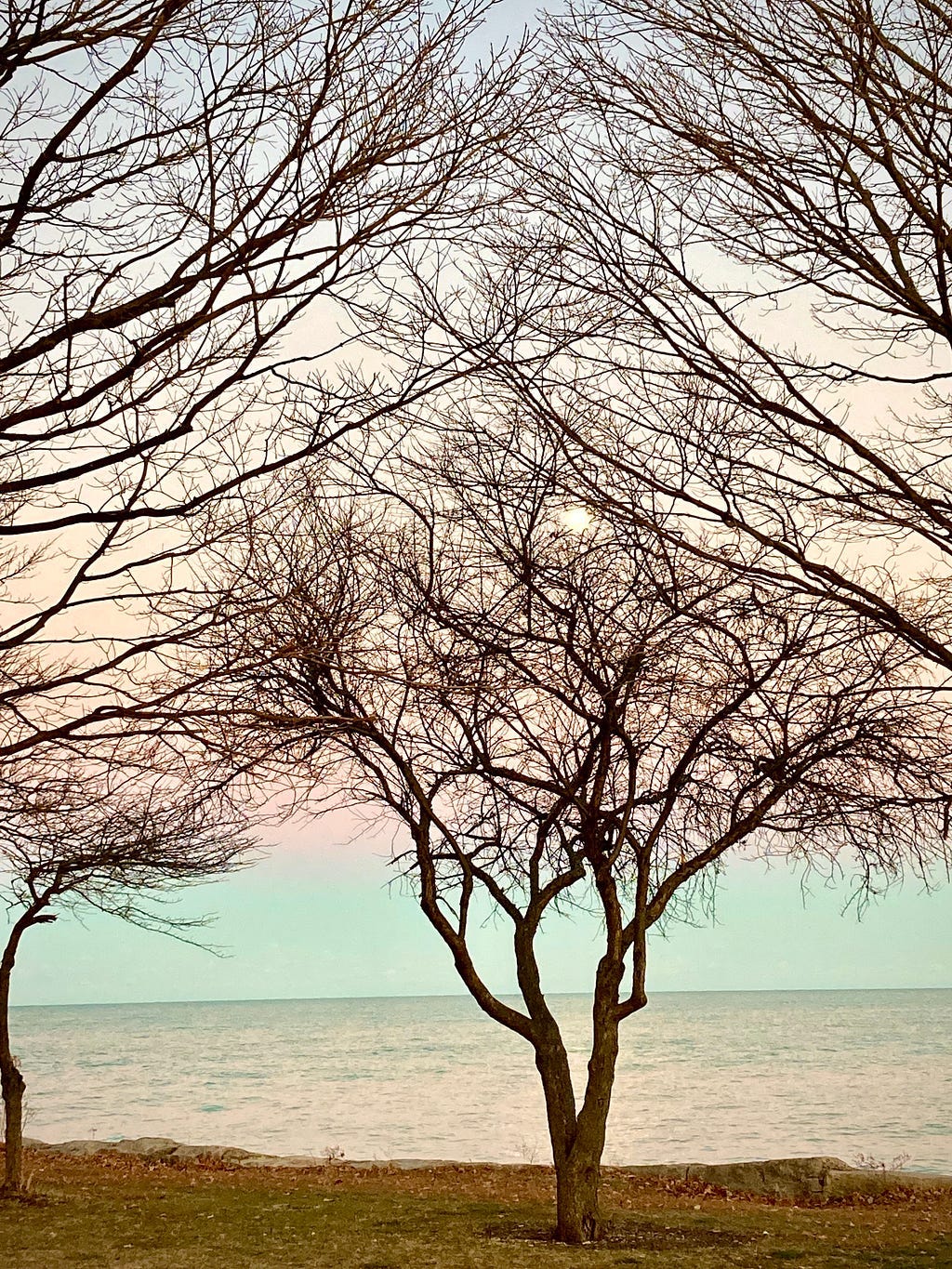
But the bare trees did feel less distant now, and it felt like I disturbed their gentle slumber with my soliloquies as I drew closer to them. They stared back, meaning to ask why I was gallivanting alone by the water. Without the chador of their leaves, they either seemed to bleed great worry or an immense unfiltered joy. I suppose it depended on who was looking, I thought.
A’s arrival could not have been better timed. I would often walk with him, or I would simply go to his house. His apartment was calm and undramatic. It made me feel home, like I could relax my body.
Whether in reality or in our imaginations, we had all been exceptionally busy that time of the year with this or that. But he would make time.
It seemed like he did not segment time like I did, like how I divided it into neatly splintered fragments for me to impose my will on it. The way he spoke about his life made me feel that the time he inhabited was fundamentally different than the one I did; the streams of time that he lived through seemed to converge harmoniously in the now: moving yet still.
I had imposed on time a misplaced order. I had, perhaps, unknowingly, sought to extract from time its divinely imbued spontaneity. My meticulous yet inexpertly sketched to-do list, that I neither followed fully nor could I dispose off, bore witness to this. I had demanded control, I had tried to possess time, and for that I would feel my heart become smaller. The world would seem smaller. Perhaps, I had, like others before me, disturbed some law of nature.
We would walk together often, A and I, talking about many things; how life weighed heavily on the ways we had imagined our lives to unfold, or whether the stories of our dreams would ever come true.
We spoke about the ethics of friendship as we saw bonds being decayed by the seemingly unending reign of disease. We knew that being a friend without knowing how to be one was a pyrrhic achievement at best, and so we asked what it meant to be a good friend in such times. We had no good answers except that friendship was either difficult, easy, or both. It was easy when you found those who saw you as a human with needs, cared how you were, saw value in your fragility, and held you close despite your fragmented soul, while you did the same for them, sometimes equally, sometimes less than, and sometimes more than, but always in cognizance of achieving an equitable mean, of meeting each other at the confluence of our mutually constituted visions of life. Yet, friendship was difficult when you could neither find nor be found by such people.
Other people were the main characters of their own lives, not appendages of ours, that much was clear, and we did not expect anything else. We spoke about being burned by the vicissitudes of time, of how its illumination broke us, how it left in its absence pain and eventual clarity.
There was also the problem of kindness. I did believe in kindness, just not very much in words of kindness. One could either do the ethical thing or the pragmatic thing; one could either believe to see kindness everywhere or to not do so unless given good reason. I oscillated between the two, in the grey, my hope often colliding with my experience, both strangling one another, trying to come out on top.
A would listen intently, not hurrying to intervene. Not having to edit myself much, something still unfamiliar even after all this time, must have impaired my generally adequate ability to listen, but I do remember that he, one way or the other, had reassured me that it would all be fine, that we were okay.
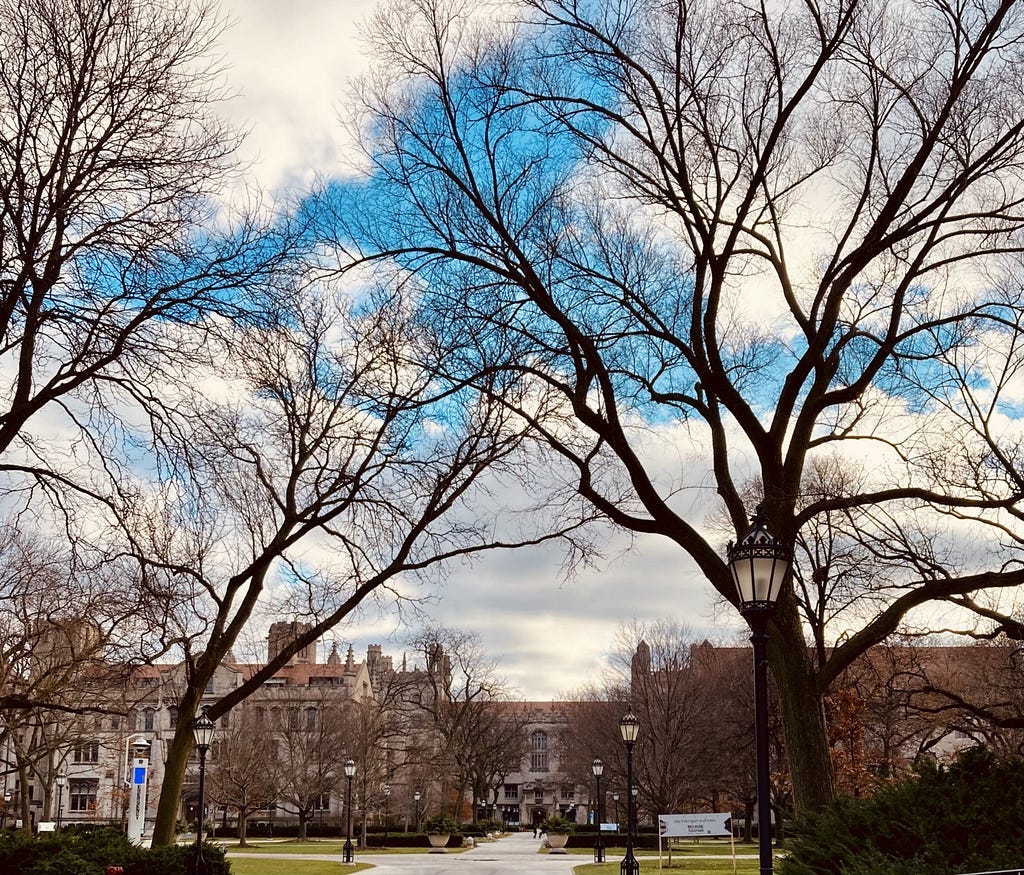
We would walk by campus. It seemed like another world, sheltered from the city outside like it was, it felt warmer. The trees lining its wide avenues were undraped too, but they felt different from the ones by the shore. They seemed less anxious, less worried, maybe because they saw me with company.
We would walk together till late at night even though cold Chicago winds would try to coax us back inside our heated walls. Our little back and forth colloquy would be warmth enough.
He would have his tasbeeh with him always. It was long, with many beads, lightly brown, and always wrapped around his fingers as we spoke back and forth about this or that. Sometimes it would rain, but we would keep walking unbothered, hopping over puddles by the crosswalk, stopping to take shelter under sides of darkened apartment buildings as we continued conversing, gesticulating excitedly to make this or that point.
But soon enough, it was time for us to part ways. I was unsure of when we would see each other again. I did not know what to leave with him except my Qur’an. This particular copy had been bestowed on me by a friend some years ago; it was a mystical translation from a South Asian branch of the Naqshbandi sufis.
I had met this friend and other members of their spiritual path, their tariqa, in Makkah. I became drawn to them because they exuded a stillness I did not have. When we parted ways, my friend gave me his Qur’an; it was published in some printing house in Pakistan but it came to be in my hands in a land far from home. With A, it was time for it be passed on again, and doing so was not any logical decision. I am not sure whether there was much choice: I felt impelled.
While I had always adored its pretty calligraphed cover, I had not read much from it. Yet, I did often hold it in times of need; I thought feeling it or looking at it would do something, and maybe it did. I held it out to A, asking him to take it from me, and he did, his head swirling a bit as it usually did.
As he took the Qur’an with one hand, the fingers of his other hand unfurled from around his tasbeeh, and he asked me to have it. Despite my internalized conditioning that compelled me to question the need for this takalluf, I did not hesitate much to accept it.
Things received from those in your heart were never like the perfunctory offerings made in service of fulfilling some formulaic societal obligation. Our exchange was not a matter of choice, of any calculation, nor of an expectation of reciprocation: it just was. In some ways, it transcended us. We had not been possessors but mere caretakers of these companions of ours. Yet, in our watch over them, we had left imbued in them little indelible bits of us.
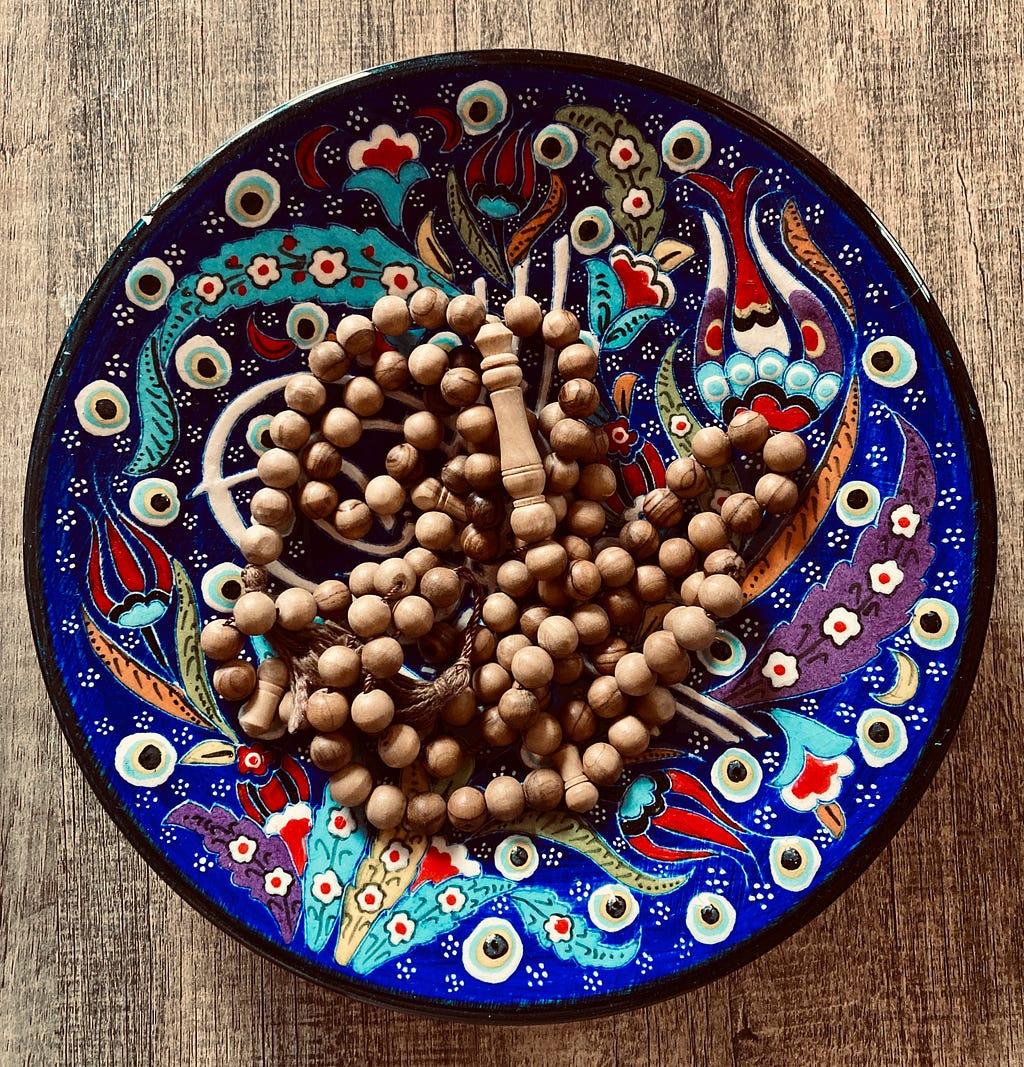
He had gotten his tasbeeh in Egypt, I think, from whom I do not know, but it had been through much — that much I could tell; its beads contained in them an entire tradition, an entire history.
Now it was mine to hold. In our exchange, light and uncomplicated as it was, we were not bestowers of meaning onto these objects, but rather it was them that would hold our friendship in absentia.
I would not speak much with A after we parted ways for it was a relationship nurtured by physical presence, but parting was not separation. And even though I did not know what would become of us as friends, I would keep his tasbeeh close; I still do.
We have so many memories that dance around in our hearts. They come and go without any declaration. Yet in the physicality of the objects that live with us, we find an anchor that keeps the remnants of our memories safe much better than the fallibility of our minds can. In their unnerving ability to transcend space and time, distort them, make them less than linear, they let our memories collide in unexpected ways, letting them coalesce into stories that we hold dearly. These objects are far from inanimate; they hold in their architectures the fragments of our conjoined lives, of our happiness, of our grief. In doing so, they make it slightly easy for us to not miss the years disfigured, misconstrued, or simply erased by our minds.
With time, they gently transition from being simulacra of our relationships to being placeholders of who we were as people, of how we changed slowly, in indistinguishable increments, and of how things remain familiar but never exactly the same.
I don’t know if I could ever have such a harmonious relationship with time as A did, but I do know that time ill-spent is time rushed through, and despite our haste, such moments pass slowly, agonizingly, in agitation of not being somewhere other than where we are, in anger at our inability to bypass the pains and aches of inhabiting the here and now.
Time well spent defies linearity; it flows slowly in our minds but quickly in objective measurement. This slowness is gentle, calm and curative, unlike the harsh slowness of rushing. When time lets us into its private garden, our perception of it collides with our norms of quantification. Our minds start to loosen their infatuation with the orderly fidgeting of the hour hand; we start resisting its pull, one that beckons us to walk our lives in subservience to its unrelenting ticking. And as we do, we become engrossed, captivated, fixated — in the best way possible.
In its warm embrace, time makes us acquiesce to the demands of its creed. It demands of us to see things for what they are, not what we wish them to be. It asks us not to profess our wholeness but only our brokenness, it asks us to not be good but to do good, and if we fail and fall, it lifts us back up, telling us it’s okay, just like our mothers did when our feet were smaller than apples.
And like that, we become members of this creed of fallibility. And like that, time lets us in, if not fully, then enough for us to see hopeful futures and gentler pasts. And like that, it lets us feel that we are enough, even if we may have some ways to go in being the people we could be. And like that, it lets us enter its cradle, where it allows us the ultimate gratification of being free from thinking about it.
And it is precisely when we stop thinking about time that we come alive. And it is then that our eyes light up even without the sun, our pupils expanding concomitantly as if to make space for the acceptance of our finitude to enter us. And it is precisely then that our half-loves, tainted by our distracted grazings in this world of ours, alchemize into something more, something fuller, something less lonely. And it is then that every moment with those whom we love becomes like our last moment with them, without any pretension of control, like we are fully there, but always ready to let go if time summons.