Notes: I
have you left enough stories of you to be retold, over and over again?
and the mercy of your Lord will shatter your sense of self, of how from utter strength to weakness He compels you, and of how from raging humiliation He brings you forth, delivered and rescued. קָר֣וֹב יְ֭הֹוָה לְנִשְׁבְּרֵי־לֵ֑ב וְאֶת־דַּכְּאֵי־ר֥וּחַ יוֹשִֽׁיעַ.
sometimes there is an anxiety to worship your Lord at all times, to feel disturbed in the moments where the mind wanders away from the realization that He exists; it is important to nurture this anxiety but to keep it internal, not as a source of chaos for others.
proper morality is a mesh, not a wall. it has shape, substance, strength, but it allows stretch, elasticity, a proper way to buffer tension. running into it won’t destroy one. rather, at its best, it softens the blow.
sometimes the same moral objective may very well be achieved through a veneer that doesn’t look so.
everything must be done with a degree of madness, nonchalance brings death.
God can create a rainbow just for you. He can orchestrate the clouds to provide shade just for you. الم يعلم بأن الله يرى.
do you not feel the wall of divinity? have you not exerted yourself, having faith in your “agency,” in your self-perceived capacity of enacting a re-arrangement of the world through your work, and wound up bound, unable to be efficacious? that is the wall of divinity, constraining you and then expanding you. make peace with it, for if the Lord wanted, you would be in a different state than you are.
using “muslimness” as a mark of spiritual superiority, of distinctiveness. over other muslims and ones who are not is a mark of immature metaphysics. metaphysical racialization has both spiritual and political ramifications, usually not beneficial.
if you could fully grasp where people come from, what constitutes their being, you would realize that judgement as a social concept would mean very little.
take your share of joy whenever you can, even if it may be very small.
romantic attachment to loss, subaltern characteristic, can be powerful, but often misused.
loss is meant to be a future oriented state, temperament, akin to a person rolling down a hill, downwards but forwards.
you know the people you love through the voice of their footsteps.
a mechanical attitude towards “self-improvement” makes a person worse in their being. improving the self in a modern sense is alienating. it is better to learn how to “live” than to improve the self.
deaths emancipate the spirit from the drudgery of socialization, imbues in it not a simple hatred for it, but rather a radical acceptance, a love, of the brokenness of society, culture, and time.
الإنسان الكامل, the isthmus, can see colors that other cannot, it can be a station or a state, all this can be inferred. the one at the station can see those color at all times. the state can be just be ephemeral gift from God, for the man to experience the divine in the material. however, once the man loses that state, he may experience severe bouts of melancholy, for to have experience the divine and then be shrouded by the metallic darkness of the world, by the incapacity of perception, is infernal.
speak to people in the barzakh, they might be able to put in a good word for you.
honoring tradition, the past, is done best by a radical futurity, not by being haunted by loss. the two extremes of finding in the past material for soapy romanticism or attempts to revive cold logic are both just that, extremes. complaints of the modern world being too mechanical or too emotional are self-perpetuating caricatures. just live, it’s not complicated, God will announce Himself intuitively, and with that, the perfect synthesis, the proper blend, of love and reason will dominate.
there is little that is “traditional” about “tradition.” most understanding of it comes from perception, which by its nature is not static, it jumps from point to point in time and space.
spiritualizing of the spirit, of the rūḥ, can be a sickness. make it real, make it material. to do so is not a crude materialism, it is the acceptance of the fact that perception/s splinter so much as to become useless. hence, the geist needs mass to be real, otherwise it becomes abstract reflections and refractions of the mind. time exists and it doesn’t exist, but to make it not exist, one has to annihilate himself into it, right through the empirical facts of life, being and non-being then are the same.
nothing about the past and present is irreconcilable or incommensurable; that is the glory of God. the assumption and then the knowledge of His existence necessitates this. yes, eschatological time is generally considered as degenerative, but from a Higher vantage point, it is is value-neutral. the locally divine, meaning the God-given ability of man, is able to produce perfect alchemies of existence, of love and beauty, at all times, even a second before what is perceived as the cataclysm.
you are born on the day where you realize you exist, as something real in time, as something that is material, capable of movement.
the first time a man says “back in my day,” he surprises even himself. after that, it becomes a self-indulgent balm for the psyche.
having mercy on one’s self is infinitely harder than God’s willingness to be merciful.
the cracks in your self are worthy of God’s love.
at the height of suffering, when all days recycled without much joy, there was always a very brief moment of light, extinguished shortly after by the overwhelming reality.
the highest pleasure is perhaps merely sitting by a cliff, letting the sea breeze touch your face, what else could surpass that? to be whole in mind, body, and soul and witness a perfectly crafted tapestry, what a shame for the many who are restricted from even that.
often the pain of others for your own is more devastating for the self.
hope is not a feeling, it is an orientation, that despite suffering, there are always modes of moving forward.
remember God at all moments and take care of people, there is nothing else that matters.
a desire to delve into logic, in supposed opposition to love, to compensate for some sense of perceived loss, be it individual or civilizational, will not result in the positive outcomes one hopes for. to delve into love to find refuge from the reality of the now will neither. only merging the substructures of logic and love will do.
only God can adjudicate moral superiority of one man over another. yes, there are signs and symbols, but they are not the definitive ḥukm. to deliver such a verdict towards the end of gratifying the self is dangerous.
a space that cannot accommodate the unorthodox is destructive.
the past cannot be recreated, all movement is forward. if you could recreate the past, time would cease to exist. if you are recreating the past, what would those in the future do when looking at you?
hoppípolla.
God may induce such a darkness onto the believer’s perception to only make the light clearer.
miracles unveiling themselves at glacial pace make themselves imperceptible to man. indeed, خلق الانسان من عجل ساريكم اياتي فلا تستعجلون.
what miracles are you looking for? is there more a miracle than being in heaven, seeing the face of your Lord?
God may induce a hundred deaths before physical demise, and the purpose may remain perplexing.
there is no other viable course of action than to submit in the measured arrangement of your life in face of unchangeable circumstances.
tragedy is the best revealer of the level of attachment one has to the material existence.
settled urban life induces strange attachments because civilization erases the spontaneity so constitutive of nature.
don’t worry about the “caliphate.” check up on your neighbour, clean your street, pet the cat, all this is not “apolitical.”
under appreciation of purpose is a disease, obviously. yet, an over fixation on purpose too is a disease. in the latter state of being, one forgets to live, overlooks that the highest form of life can be feeling the joy of walking on your two feet, to be able to smell, to see. a proper cognition of these abilities frees man from said over fixation. the same level of work towards a purpose can exerted without unnecessarily exerting one’s spirit.
the sick man is rendered invisible first to himself and then to the outside world. he stops existing.
do you not wonder why the child that falls of the tall monkey bar often comes away scratch less? do you not think something eases the fall of the sinless?
rather than humbling yourself to the reality of your own existence, you squander your time bartering with God to rid you of your misfortunes.
a man of God may be a brute, but he cannot be a villain.
wounds are theophanies. the scars your Lord inflicts on the body, mind, or soul, are marks of domination, of asserting ownership over his servants.
new cars are analogous to smart phones. they are means of alienating man from the built environment he is treading upon, and rather than one operating a vehicle, it is the case now that the vehicle aims to operate itself, making the user increasingly superfluous, inducing a sort of distracted state so reminiscent of the information era.
being blessed and feeling blessed do not always coincide, the latter can often be a delusion.
why are you in love with a grief that exerts itself viciously to escape? even in your being, you know you are able to declaw your spirit from the pleasure that this grief induces, yet you don’t. to find this joy in grief, it must then be elemental. in that case, is it really grief anymore? it is just you.
care is all we have.
pain is real, but for the believer it ends. that is greatest of realizations. it ends. it cannot go on forever, it burns out, even if takes a hundred years.
grief exists in both thought, as in cognitively, and in the soul, more diffused without location. in the aftermath of tragedy, grief takes root on both these levels. it makes a difference if the traumatic episode was a singular event in time or recurring one. in any case, to move forward requires a broad array of techniques, from excision to nurturing.
phenomenological experience is unstable, viciously changing its perceptive angles. Such a basis of experience can, by its nature, not provide steady bearings for the soul. this is evidenced by basic empirical proof: even if nothing goes “wrong,” subjectively determined, a person may complain of feeling forlorn. psychoanalysts may seek to attribute such a state to some hidden factor that is imperceptible to the patient. Nonetheless, the person afflicted may still say nothing is causing them grief, the eternal existential problem. If something goes “wrong,” based on more commonly agreed upon metrics like sickness or death, at the very least there is clear cause. In either case, the soul recognizes a persistent unmooring, a material sense of impermanence, and without a proper psycho-spiritual orientation, ان الانسان لفي خسر.
better people than you have suffered utterly more than you, let the sense of shock go.
all of life comes down to perception, we are born with perceptive biases from the start to the end, and everything else is a creation of that. the sea, the anger, the coveting, the road, the wall, divinity; it is all perception.
probability becomes a hundred when it happens to you.
even good doctors and good science can belong to a tyrannical dogmatic cult.
low trust societies exhibit certain symptoms: intense staring, aiming to estimate danger, animalistic.
the believer in expansion often aims to pray five times a day. the one in suffering prays all day, often without prostration.
we are also organisms of this Earth, we are inscribed in its dna. there is no distinction between man and nature, just as there is no separating your blood from your bones.
leaving your affairs to your Lord is not complacence, it is the material acceptance of the limitations that are constitutive of yourself.
we imagine all sorts of differences with others upon whom immense suffering has been imposed. moral difference, cultural difference, familial distance, political difference, existential difference, and so on. it is just fate, donning the garb of life.
never comment on the quality of food; imagine the scenario where you could not even get food down your throat.
the prosperity of modernity is structured around particular axes of geography and the built environment. most of it has been produced, obviously, through a dominating relationship to land. it’s always hard to analyze how geography operates as a historical fulcrum.
amongst the worst traits of man, particularly modern man, is the annoyance he exhibits when his life veers even slightly from the track he imagined it to be traversing.
good and evil cannot occupy a vessel at the same time without explosive alchemies, there is no admixture that does not exude a viscous mess. if there is indeed this adulteration, that is corruption, good becomes tainted, by being covetous mainly, evil becomes tempered by guilt and repentance.
it is habitual to love your own tribe, your own people, first, to prioritize their ends and aspirations. there is good in that, especially if your people have rightful ends, ones either demanding justice or producing beauty. still, if it can be helped, one has to transcend the love for the tribe, and habituate himself to love what are the ideal averaged ends for all of society.
medicine should be taught in monasteries.
“wrestle” with God while knowing there is no wrestling with God, لا يسأل عما يفعل وهم يسألون.
in the gulf lie the true enemies of faith, goodness, and the truth, consumed by gold, a false sense of religion, buried by prosperity, a trial of the highest order, at least the nomad with punctures in his shirt, wandering the streets of the Punjab, is not bewildered or deluded by the jewels of the world. all wealth must be depersonalized, to have it and hold one’s hand at the bare minimum is the right struggle of the soul. ἀκούσατε, ἀδελφοί μου ἀγαπητοί. οὐχ ὁ θεὸς ἐξελέξατο τοὺς πτωχοὺς τῷ κόσμῳ πλουσίους ἐν πίστει καὶ κληρονόμους τῆς βασιλείας ἧς ἐπηγγείλατο τοῖς ἀγαπῶσιν αὐτόν.
undignified poverty breeds barbarity, especially in its patriarchal iterations, wherein men oppress women and women oppress other women, as on show in most of the the so-called post-colonial third world. whereas, a lack of material resources in a societal setting that is able to organize relations in a more refined fashion is still fairly bearable, even something a primal good, potentially even better than hyper-financialized capitalistic societies that come with a whole set of associated spiritual, societal, and economic issues.
love the cripple, he may be freer than you.
help others even if you are the cripple.
death lurks in every corner.
exerting oneself to determine the “religious,” for example the “islamic,” is frequently a low level academic activity. often done to produce analysis where none is emerging intuitively from the self. time would be better spent on refining the heart, mind, and the soul so as to enable one to ask better questions in the first place.
his loss blotted out the sun. lately, the brightest of days looked like days of the eclipse.
what is more real? pain or joy?
opression looms large in the pure land. what spark can remedy centuries of rot.
true tragedy is an epistemic event, meaning it alters the architecture of one’s beliefs on the level of the soul. most vulnerable to this is one’s own self-perception. after severe material loss, the man asks the question “who even am I?” tragedy then is not the event, not a focal point in time and space, it is what remains behind, or rather what remains ahead.
all intellect fails as fate strikes.
the nation-state is not some exogenous franksteinish entity. it is just lackadaisical to think that it is one thing, one general structure that only oppresses, that it is merely an arrangement of oppressive power. certainly, it is an arrangement of power generally, but it is not always a foregone conclusion that it should be sauronish entity.
tissue is created to mature perfectly as man is born. later, as wounds injure him, he matures through scar tissue, but not perfectly. that, in some ways, is the story of man. he is born through divine programs, connected to the space he comes from in the world that was before. once on this earth, there is no perfection. what is broken must be mend, through tears, scars, sutures, welds. there is always a mark left in the lesion, which sometimes cannot be seen by the naked eyes, but the imperfection remains. but, but! God has no limits to what is possible. if later, the scar heals without trace of the wound, it would mean eternal divinity has entered a new stage in human history.
who can dignify the sullied sick man, with wounds all across his body, soul, and mind, who no longer has space in society or even in his own personhood? al-laṭīf.
it is a pity that the eyes only open after death. the highest of mystical tasks has always been to see here and now what one is ordinarily only able to see after death.
a good intellect can still lack introspection, a clear understanding of the progression of their life, a grasp on the passing of time.
critique as an academic tool starts corrupting the soul when employed outside of a narrow healthy epistemic domain.
average person thinking civilizationally is not useful. water your plants, be kind to the weak. civilization is a second order outcome. it is not a “political” instrument.
sovereignty is an abused concept. in its most crude sense, that of “political” sovereignty, expressed by some vague notion of exerting unilateral power within fixed borders, is often harmful to the ordinary people. great crimes and suffering have been imposed based on some fractured understanding of maintaining sovereignty. power players would rather exert this sort of vulgar sovereignty even at the cost of decimating the lives of their constituents. this sort of sovereignty is only perhaps liberating or life-enhancing if coupled by a corresponding increase in the quality of life of the people.
cry everyday; there are always reasons to cry every day, and to not do so is a step towards death, وتولى عنهم وقال يأسفى على يوسف وابيضت عيناه من الحزن فهو كظيم.
do not get lost in being a “muslim.” pray, obey your Lord and love the Prophet, submit but do not reduce yourself to this thing that you are that has to defend its existence on the civilizational scale, you are much more precious than that.
surviving tragedies comes with the tethered effect of joy and pleasure migrating from lofty social ideals to the fundamental facts of life: steps, plants, air.
and so it continues, long after you are dust, the spirit of man lives on, in memories, traces, and synchronicities.
remember the dead. read obituaries from towns you do not belong to. would you not want to be remembered when you die? remembering the dead accords them a dignity that is so basic to the proper human experience.
the “doctor” is often the tyrant.
learn to feel like the cripple, the forsaken, the orphan, the widow, the poor, the dying, even if you are not.
the idea of legacy generally populates the mind at an older age when man is more cognizant that he is mortal. the notion of being remembered is not primarily about “leaving behind” something of value for those in one’s circle of socialization, but rather it is a presentist act that comforts the mind and the ego, it is a self-soothing attempt to solidify the feeling that one really exists.
there was moment, a period, during the technological revolution when utility of invention became inversely correlated to human well-being. the threshold of utility was crossed, and while it made sense to reach that point, the forces of production, obviously, could not be stopped at the equilibrium where mental well being was perfectly harmonized with the levels of mechanical change.
being dogmatic is unintelligent for many reasons, but the primary one is the mere fact that we do not know enough about the nature of the universe, of matter, to be so.
to feel persistent shock over tragedies requires excessive entitlement.
retrospective moralization after the fact of tragedy is a devastatingly human trait.
anger can never be a primary virtue, rage can never be productive. it’s self-defeating, pyrrhic. the tough things must be done out of love. anger as expression versus anger as motive are very separate.
when you break the pillars of common sense, there is no longer a referent to guide action, anything goes.
it is unclear whether weeping and silence, or laughter and outbursts, constitute the best medicine for the soul. perhaps both. there is no clear reason either should not have the same underlying mechanics.
one more day, it might still be.
ever since I have gained consciousness, I have been trying, my lord.
in the first moment sleep breaks, God leaves an impression on the mind of what’s to come.
every tragedy is all consuming, until the next bigger one.
what is miraculous or not is often defined by frequency in an inverse relation, not essentially by the quality of the event.
there is no wrestling with destiny once it has imposed itself. before it does, one can, at least in perception, wrestle with the outcome of time.
I remain too weak to force my will to coincide with yours, Lord. Forgive us for what we aim but fail to do. Is it not your will that is too lofty?
gratitude is modulated on a sliding scale. more precisely, increasing gradations of deprivation and suffering is the only way, for the ordinary, to develop and refine their sense of gratitude.
anything may destroy you, that is life.
the quranic ethos is an umbrella over all other scripture; it pulls closer their cracks, gives them merciful shade.
take a bath 3 times a day, drink bottled water ruthlessly extracted from hundreds of miles away.
a year is not long.
the only three states of freedom: death, disability, or annihilation in God.
help me! to trust you, God.
winter abound, make or break.
the devil has disappeared from discourse, partly explained by the hypertrophic growth of the self, which, with its associated bloating, affects perception, in turn allowing the spirit of the devil respite to dissipate into structures of society.
yet, if this is to be age of the individual, of the self, then so be it. it does not necessarily have to be the age of the meretricious self, it could be the age of the divine self, of the glorious flourishing of the human spirit, of one man, not a great man, just a man able to unite the part to the whole, totum simul.
wash yourself with tears from the sky, of divine nature crying to give life to the dying, to the rotting.
forgiveness derived from guilt is an inferior type, a negative virtue, than the one derived from the conscious or unconscious abdication of potential, a positive virtue.
karbala is islam’s christian suffering.
saviors are stupid, save yourself.
Faith: belief without experience, not belief without evidence. evidence may be repeated frequently on separate occasions, but it is not real unless subjective. However, experience, the subjective and visceral contact with the object of belief, is real, in a material way.
theorizing or opining about the ummah is indulgent at best and harmful at worst. it is not an idea to be thought and implemented. it is a second level outcome of acts, not a first level one.
cleaning a dirty street is piety.
I saw the Prophet sitting on a mat, with his back against the stone wall. I sat by his crossed legs, with my head bowed as in severe need of him. He looked at me with a mending smile and held my head to let me cry as I held his leg like a drowning man. and his companion then said: you had made a wish to join this highest of assemblies, but did you pay your dues? I asked: what dues as I held on to his leg as he stayed silent, onlooking. the companion replied: you made a wish for the loftiest of heavens, for the gift of our presence. I commend you for your ambitions, but then you, unready as you were, asked for a life of grief, your entry to this gathering.
“I have seen their ways, but I will heal them; I will guide them and restore comfort to Israel’s mourners, creating praise on their lips. “Peace, peace, to those far and near,” says the Lord. “And I will heal them.”
a basic islamic premise may be said to be the fact of religion being for all times and places. a priori, then, modernity has to be a friend of religion. anything less is just a failure of imagination or will.
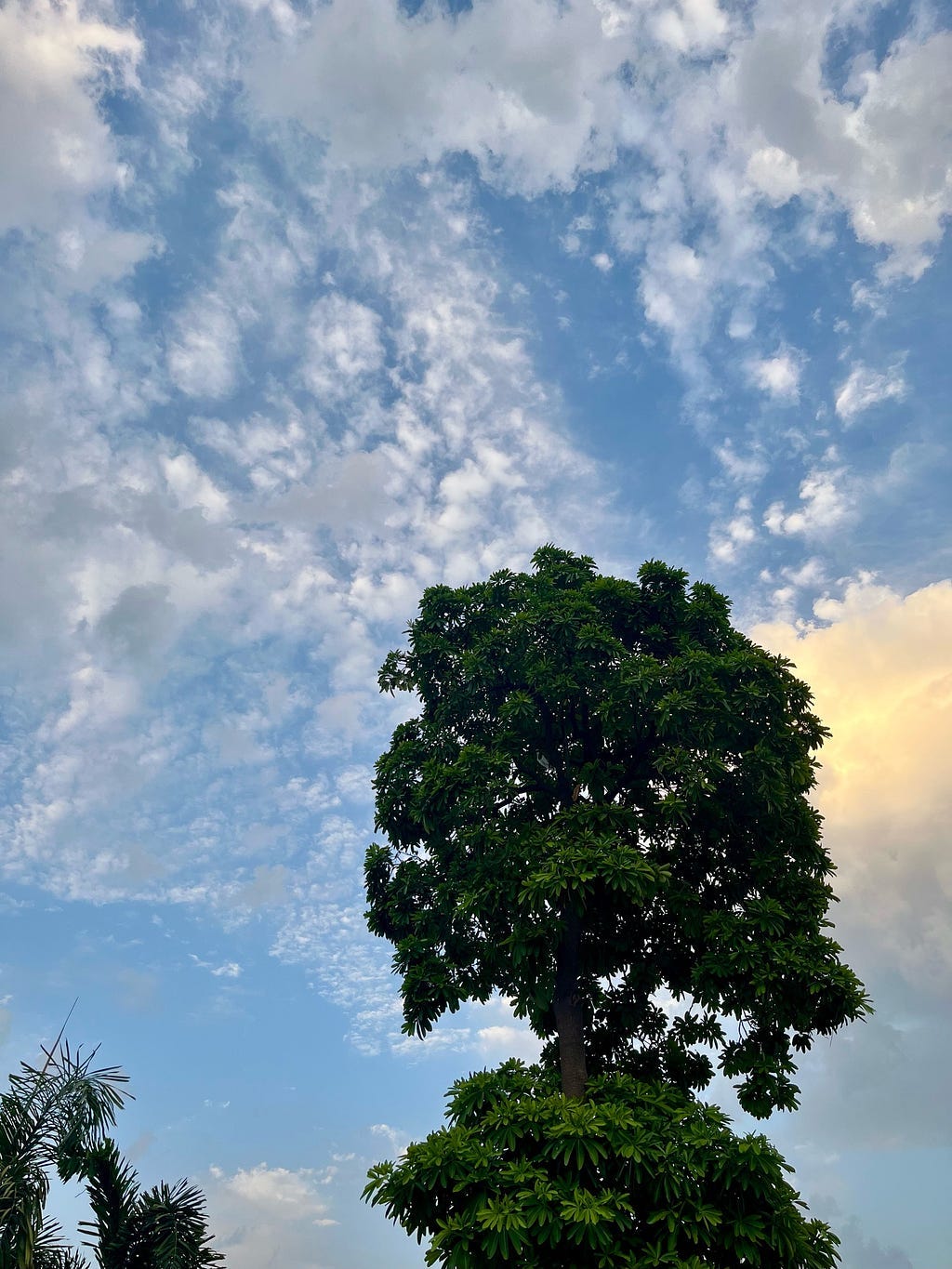
The value of a clear sky, with glimpses of a cloud, is lost on the free. Only the imprisoned can understand, in earnest, what a sky is. perhaps even on a more basic level, the sky may very well be a child’s realization of divinity. what else can captivate the soul, the senses, to that degree? specks of orange in the sky? the great painters of our and previous ages have always took to the sky to find refuge from the superficial dimensions of society. arguably nothing represents man’s innate disposition to find release from bodily experience than his desire for the sky, for the mysteries harbored within, for the potential of life yet witheld.
The template is there, so it can be achieved. It exists in a moment, so it can exist in many moments.
Is death momentous or merely just there? A grand rupture or?
why would you not wish to be united with your Lord? when you know even the most pleasurable moment of your life, in which you felt no pain or grief, was so ephemeral. is it not true that the entire map of human history is splattered with an aching desire to eradicate the perception of pain? from the debauchery of the wayward to the trance of the mystic, what else is the goal? man knows innately that there is the possibility of a creating permanence to unending relief from pain, but he also innately know that it cannot be brought into existence into this world, the famed kingdom of God. perhaps, it can to some limited extent, but never fully, even the highest of mystics would concede to the claim that we have to settle for good enough, that death is the precondition for what man pursues so fervently. what is to be done then? the realization that this world is both an anemic iteration for heaven and for hell is dizzying at first to the man who yields to it fully in spirit, when he moves beyond an intellectual acceptance to a total agreement to the fact. even in the most wondrous of meadows, with lush tapestries of green, you will always find the rotting dead wood and dying patches of grass, but then even in the gulag, you might witness the piercing beauty of a speck of the sun, lancing through the tiniest of cracks to plant a kiss of divine warmth on to your cheek. all of life is that, unstable, so why would you not wish to be united with your Lord?
glorious resolve.
“corruption” is very simply just incompetence, needs no great analytical efforts.
many critiques of secularism are remarkably stupid because they wish to rescue religion or tradition from the clutches of a modernity seeking to regulate them. the only useful ones are perhaps those that imagine religion or tradition as friends of modernity, of the awful nation state, and if it is innately violent, temper it, soothe it. it is simply a failure of imagination of being so beholden to the past, that one is almost afraid of imagining a future that accepts the present, the status quo, the raw hard empirical facts, now that is a romanticism of the highest order. idealism can be an excuisite good but not as a general principle of thought. no room for idiotic fatalism and its deceptively warm refuge of history.
structured chaos, within the bounds of certain organizing principles, rapid movement, the daze of spontaneity.
choice and free will are perhaps the most privileged concepts in human history.
fate accounts for the “random,” for the statistically unpredictable on the subjective level.
the heart must burn even for the worst of men, for how they desecrate their souls, for how they erect an impermeable wall between themselves and all that is kind and beautiful, divine.
I know not what is better for me, constriction or expansion.
take a bath, what a wondrous affair.
expanding the boundaries of life, of experience, directly constrains the enormity of tragedy.
even after being ravaged, being undone by loss, the human spirit has to persevere, until it can return to its maker.
near death experiences, the only real chance to burn the impurities of gold away. often missed in the relief of being delivered.
the blessing of suffering can only be called as such by those who have suffered.
death opens doors.
exclusively needing religion to be “good” is a betrayal to nature. religion can be so much more than a tool to be “good” in the narrowest sense. art, beauty, and science, now these are religious. religion is not the purview of scared clerics, it is the universal spark that animates life itself, bewilderment, amazement, light, and the magical. mutating the religious into only norms is the death of it; norms are only the elemental step, and to make them the apex is criminal to the potential of the human spirit. there’s quite little need to speak about the “religious,” what had to be said has mostly been said, what remains is the easiness, the flowing, the river like action of the religious that is left, haranguing people about it, making them sit down to “remind” them is mostly an impulse of the ego, to “impart” knowledge may be exhibited as virtue but more often than not it is an industry of doom. this sort of religion has hamstrung society, a sort of severe arrested development, with no relation to the modern sense of “development,” but rather a more a primal one.
of suffering, there remain many a kind. yet, ultimately, when logic and casuistry, or both, end, the only split, the dividing line so to speak, in material experience remains the state of health or sickness. religionists or others may speak to other forms of intangible maladies of the soul or else, but phenomenological experience reaches its boundary of reality in the viscerality of pain.
childlike wonder, elderly wisdom.
the magnitude of the tragedy is decided by the psyche. it is thoroughly subjective on the singular phenomenological level. objective analyses assume a wrongful conformity of perception.
for a man, sons or daughters often represent a perpendicularity of aspirations, never quite meeting even if the desire for that intersection remains, for that equity. the daughter whose love is supremely unconditional to the father is the object of redemption, of a love not predicated on any productive value. the son is frequently a referent towards mimetic potential, meaning a vessel, a being, in which the father, rather anxiously, see himself projected in future time. as such, the son faces the brunt of being burdened with remediating the father’s misfortunes, failures, abdications, of bringing to fruition a desire of an egotistical triumph over material existence. what is lost in this architecture of familial ties is hard to ever know fully. the son is the patriarch reproduced, without volition, a savior for dreams yet unfolded. what is the daughter? a savior too, but from another self-construed prison of the father, she is the sunlight to a perception otherwise blotted out with whimsy.
shamelessness within the norms of shamefulness is radical.
we are a defeated people, and will remain so for the foreseeable time. lack of dignity, excellence, glory.
it’ll be okay.
uncertainty, hope.
I know I have not met the conditions of your love, my lord. But! Love me! You are not bound by your conditions, to say that you are would be wholly disgraceful. And I know I cannot meet those conditions in that state you have bound me to. So, love me because the anguish is too great otherwise. “How long, Lord? Will you forget me forever? How long will you hide your face from me?”
what does religion have to do with being conquered? let’s say for instance the case of the modern French army routing a band of undisciplined Mamluks in Egypt. is that because the latter’s beliefs were not in order? preposterous. even if that may have been the case, who is man to pontificate or adjudicate about it? to attempt to do God’s work is in itself grounds for defeat. the only task would have been to excel, materially, tangibly, solid, something they could not do.
the most decolonial act is to have a functioning society.
the time to think has been over for a long while. action is the only proper mode of living now.
and I would not have granted you my kingdom if I had not burned you, you would have never, on your own accord, come to me with your full heart and soul.
you’re not where I wanted you to be, so I chose this for you, so you are where you need to be.
buy gold in dubai, become party to an economy of holoucaust.
historically, most “old money” is also dubious.
I could not bear his stench and cursed it in my head, until it came to me that I, too, had been lying to die, rotting away, by everyone, those dear to me and those not. a wave of compassion overcame my heart.
I am the miracle! It is me! Why are you incessantly looking for something else?
and the pain stopped, not because it did not hurt anymore, but because the capacity to feel it had extinguished itself.
bravery from us, patronizing tears from you.
traumatic suffering radically alter the constitution of the self, the elemental blocks upholding the self have to reorganize to stitch the gaping wunds, a new man is produced and the past is sequestered away as an entity alien to the present condition.
trust no one but God, not even your mother, for she may love you but may yet cause harm to you. as for God, He does not harm for if you get harmed you will merely say that the fault was your own, or that the harm is gain in some way not yet revealed.
and it will be decades before these crimes are recognized, and by then the harm would have already occured.
very little gained from critiques of things not malevolent; it breeds attitudes of contempt not commensurate with faith and goodness
tragedy, tragedy, grief, grief ; constant self-flagellation is not respectful to memory, even if out love. there is no other choice than hope, logically, spiritually, intuitively.
dubai, doha, riyadh, hell. karachi, delhi, dhaka, hell-like. samarkand, bukhara, khiva, lost pasts.
of course, things can be developed indefinitely, but you must stop at some point.
don’t be forced to feel religious experience.
all loss can be lived through; the mind will always find an architecture of belief to compartmentalize it, be it death even.
destroy a society, let your children study said destroyed society, extracting cultural artefacts, be it art or poems, then uphold your findings as definitive understandings of said societies, teach these findings of yours to the sons of the destroyed natives, but when those native sons try to break away from the norms you create, you let them know their place, and best if it is other sons of the native that do your bidding, marry into them too if need be, always reminding them their pasts are made by you and that they have no presents until the presents become fossilized pasts.
enjoy your sandwich.
it cannot be wished away, it must end on its own
grace is dead, the minds are shattered, technologies of evil.
so self-conscious that no self-consciousness.
the anatomy of fear: terrror stricken blood, passed down generations.
often what is “impressive” is mostly grace and fortune
what is prison? it is any state of perceived constriction. time dies in prison. more precisely, it loses meaning. time becomes undressed of its social bearings. it is the theft of time. then, what is freedom after prison? it is the realization that there is still life left to live. as soon as that is grasped, there is possibility again, but first there is great instability. Kierkegaard, albeit slightly differently, speaks about anxiety as the “dizziness of freedom.” here, leaving prison creates a fundamental dilemma in one’s mind: to live as before imprisonment or to live as a new man. now, any reasonable man would determine that it would be folly to live as before, but what exactly is he supposed to transmute into? what kind of man? it is not a simple question at all. at first, he would crave to return to his habits of mind and action before he was taken prisoner. it is not unnatural to desire a return to the “pure” before. however, the problem that faces him is that he is not who he was and cannot occupy his old being. then, moving into this new life of his has to be dizzying.
by September, my dear, to see you walk on your two feet and breathe the air that has been so denied from you, would be more than all the world combined and more to me.
asking for the civilian to be supreme, but not demanding neither ensuring his excellence is just infinite regress
act with radical and absolute free will and accept your destiny
beauty can come from evil, and ugliness from piety, but only as outcomes, not as intentions
medical centralization will destroy mankind, an instrument of control, domination, and desecration of human totality, incompetency masked by veneers of authority, satanic. an ethics of care lost to greed and vanity. we think animals are domesticated, but we forget we can be too, maybe we are now. in modernity, the profession of the physician is amongst the most prone to corruption. this is because certain professions require the highest degree of ethical attention. however, such attention most readily debased by financial considerations and an inordinate fixation on vocation rather than duty. ancient and medieval philosophers in the Perso-Greek vein often used the the figure of the physician as an ideal surrogate for the just ruler, precisely because the ideal ruler like the good physician reduces harm.
i wish you made it, my friend. you were meant to do such amazing, such brilliant things. the light in your eyes, you were always so curious like a child, with those absurd button-downs.what could contain your unending spirit? your time had just come, what else could be done? what is left of you? nothing that looks like you remain, to hold and cherish. are memories enough? you were so scared that you thought you were not yourself anymore, but you were always you, and i feel sorry that we could not make you believe that. we hope you can find that home of yours now, near the trees, cliffs, and the ocean that you always imagined, with your friends near the mejlis on the meadow. we could not go there with you, and that is a tragedy. what is left behind when you took all this love with yourself? you were there, absolute in presence, resolute in perception. what now? our lives are just fragments of attention, sometimes we cannot put ourselves back together, force ourselves back into shape, through jabr, He can but who can claim to be able to ask that of him. a good spirit you were, and it was remarkable how you could be equally happy and grieved in the same moment. through eyes different than your own, if you saw yourseld, maybe you could start to believe the joy you brought us was real and solid, material. you never allowed yourself the joy of being visible. be well now.
the piano, its harmony across the breeze; van gogh’s greens and blues: the ocean and the cliff; a boat sailing away in the distance, gentle.
i was harmed! greatly harmed!
alive as I am, despite these wounds.
critiques of colonialism have reached a strange impasse. there is little on offer. repetition of trite points makes any study immediately unhelpful. critique requires a certain energy that cannot be simply conjured from one’s library. thought has exhausted itself and it cannot just emerge from a mind that has not lived through the change that it wants to bring. the restoration has not come yet because the hearts are not yet pure, free from envy. it will come but the alchemy needs to be correct. the alignment needs precision, heart, love, and care, not desire, coveting, or tartuffery.
strands of his hair started gray at speed. it was not the natural and gentle unfolding of age. it was the weight of death, imprisonment, and torture.
“right side of history” is an asinine way of moral reasoning. it unjustifiably accords “history” the final adjudication on the limits of imagination; it’s an emaciated perception of History that resembles a dead reservoir of precedents and examples, one that only passes judgment on criminality ex post facto. if, as Nietzsche warns, history is devoid of a “higher force,” a “life-giving influence,” it only serves to diminish human capacity for its highest imaginable possibilities.
field work, interrogating the archive, grappling with the sources: this is the death of love, art, and care
profits will end time
eschatological view: pessimistic futures, hopeful ends
“bloody chap, shine my shoes.” “yes sir.”
“i must write! to save myself! there is not much else left!”
what to work towards? why can it not just stop? inertia? progressing into death, destruction, and folly. the smoke, the tide, the flood. that is the natural undoing. then there is the totalitarianism of technology — complete decimation of the psyche, slow and sinister, boiling frog; gradual relinquishing of sovereignty, theft of time. yet, yet! God speaks through it all, in control always.
the “old world” was probably “better” in some ways, more primal, but there is always a way back to such a world, because it is neither old nor new, it is just there, hidden, covered by time. go sit on a mountain top, you will very quickly feel the so-called “old world.”
have hope in the miracle. If not now, then after death. if the pain does not subside now, and if it feels a journey across a dark shoreless sea, that too is okay. think of your passing not as a divide between life and death, but rather a bridge between unequal levels of perception, wherein there is little need to be scared. like the pain you felt, the mercy of your Lord is equally unending and overwhelming. we know not what minute act, thought, aspiration would tilt the scales and allow for a meeting with the assembly of the best of men, and with our Lord, and then you would say that you never suffered.

